 Rebecca Nusbaum, Ed.D.


AI Leveraged Learning
For years, my research has centered on a single question:
How does collaborative learning in digital spaces elevate professional growth?
That question drove my 2020 dissertation, Examining the Experiences of Online Professional Development: A Teacher Education Twitter-Based Professional Learning Network, where I explored how digital communities scaffold learning in ways traditional models simply can't.
Then AI entered the picture, and everything I'd been researching became possible at a scale I hadn't imagined. The same seminal foundation, Vygotsky's Zone of Proximal Development (1978), still holds.
The core idea is that we learn best when we're just beyond what we can do alone, supported by someone more knowledgeable. What AI does is catapult that.
It can serve as the More Knowledgeable Other (MKO) itself, or it can connect learners to the right humans at the right moment, without the constraints of time, availability, or one-size-fits-all delivery.
That's the thinking behind PACE, a framework I developed to describe what AI-leveraged learning actually is at its best. Personalized, Adaptive, Collaborative, Ecosystem-driven.
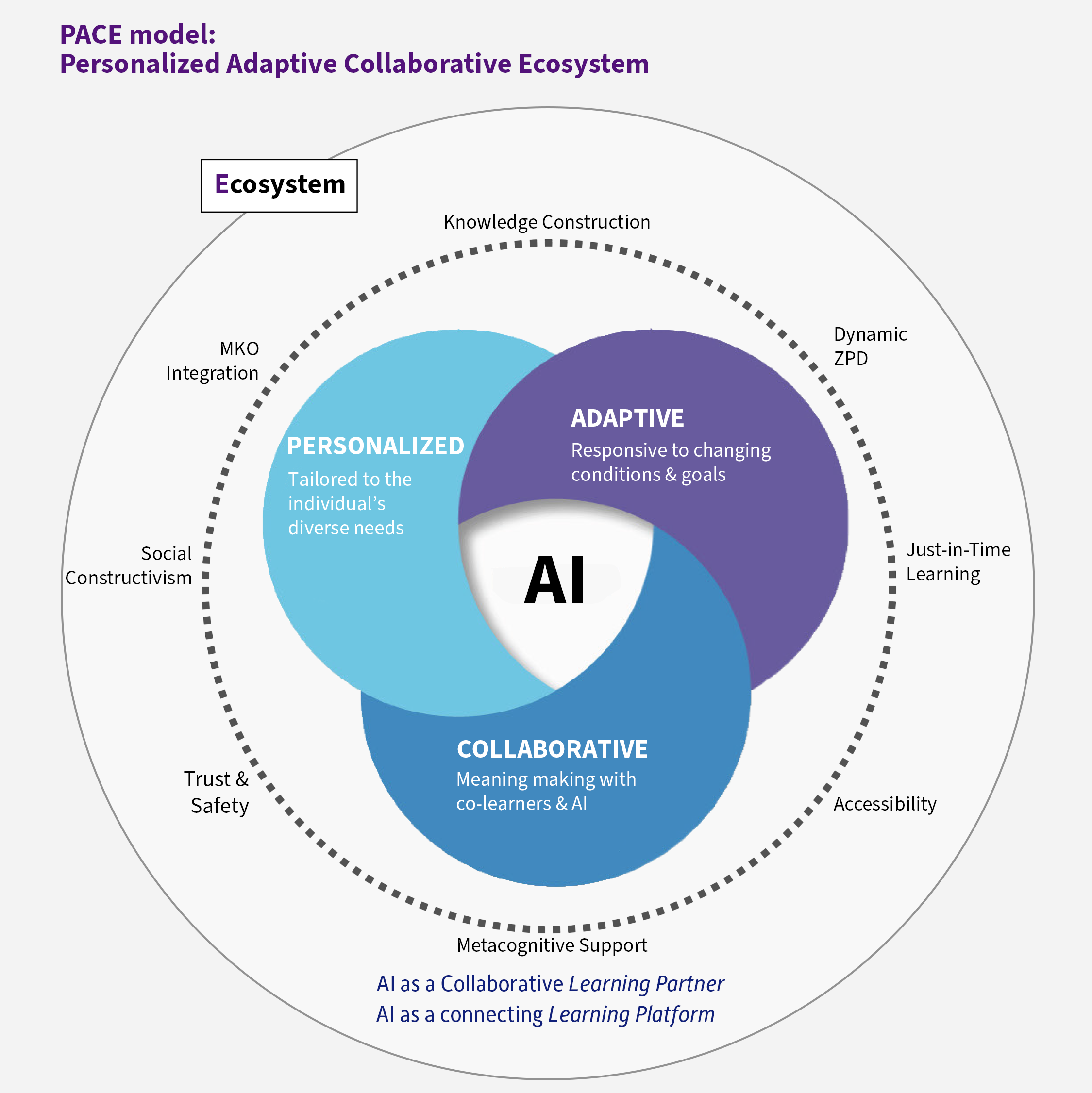
PACE
TheEcosystem
AI catapults 🚀 Vygotsky's (1978) Zone of Proximal Development (ZPD) seminal framework on learning from MKOs, More Knowledgeable Others.
AI-Leveraged learning is Personalized, Adaptive & Collaborative
- AI platforms can analyze learner interactions and performance data to dynamically group individuals with complementary skill sets, fostering peer-to-peer scaffolding within shared ZPDs.
- AI agents function as advanced MKOs, offering nuanced, adaptive feedback that evolves with the learner's progress, suggesting optimal challenges, and providing tailored hints or explanations precisely when and where they are needed.
AI extends collaborative learning beyond the limitations of human MKOs by offering continuous, scalable, and personalized support, effectively optimizing each learner's journey through their ZPD in a collective learning context.
PACE model research
RMAIIG Member Showcase:
white paper
Ed.D. EdTech dissertation
Dissertation: Examining the Experiences of Online Professional Development: A Teacher Education Twitter-Based Professional Learning Network (2020).
Themes of collaborative learning, Communities of Practice, microlearning, mentorship and coaching, Professional Development and Leadership Development, mLearning, eLearning, social constructionism, constructivism.’
Denver AI March 2026
SaaS Autopsy: Deconstructing AI's Murder of the Software Industry
EDUCAUSE Students and Technology Report: Steady through Change
https://www.educause.edu/content/2026/students-and-technology-report
Google Report: AI and the Future of Learning
https://services.google.com/fh/files/misc/future_of_learning.pdf